


Syllabus: GS3/ Economy
Context
- The Startup India initiative, launched in 2016, has significantly transformed India’s entrepreneurial ecosystem by fostering innovation, expanding access to finance, and creating a supportive policy environment.
Startup Ecosystem of india
- India is the world’s third-largest startup ecosystem (after the US and China), featuring over 120 unicorns (valued >$1 billion) and over 157,000 government-recognized startups.
- The startup ecosystem is growing at ~12–15% annually, with some years witnessing even higher growth (~30%). The number of startups rose from about 10,000 in 2016 to nearly 2.5 lakh in 2025.
- Key Sectors: Dominant sectors include Fintech, E-commerce, Supply Chain, and Health-tech.
- Regional Hubs: Bengaluru, Mumbai, Hyderabad, and Delhi-NCR.
- Job Creation Engine: Startups have generated over 21 lakh jobs, making them a major employment driver.
- Funding Landscape: Startups raised around $10–11 billion in 2025, maintaining India’s position as a top funded ecosystem.
Eligibility Criteria for a Startup
- Company Age: The period of existence and operations should not exceed 10 years from the date of incorporation.
- Company Type: Incorporated as a Private Limited Company, a Registered Partnership Firm, or a Limited Liability Partnership.
- Annual Turnover: Should have an annual turnover not exceeding Rs. 100 crore for any of the financial years since its incorporation.
- A deep tech company can consider itself a start-up for as long as 20 years and has a turnover of up to ₹300 crore.
- Original Entity: An entity should not have been formed by splitting up or reconstructing an already existing business.
Key Trends in India’s Startup Ecosystem
- Geographical Diversification: In 2016, Tier-1 cities accounted for nearly 65% of newly established startups, while Tier-3 towns contributed only 15%.
- By 2025, the trend had reversed, with Tier-3 towns accounting for about 71% of new startups and Tier-1 cities contributing only 18%.
- Demographic Trends: A majority of startup founders are below 40 years of age. Around 66% of male founders and 59% of female founders belong to this age group.
- Women account for about 21% of founders in the under-30 age group and around 33% in the 50-plus age group.
Key Drivers Behind India’s Startup Growth
- Government Support: The Startup India Initiative (2016) provided policy support, tax incentives, regulatory easing, and startup recognition.
- The Fund of Funds for Startups (₹10,000 crore), Startup India Seed Fund Scheme, and Credit Guarantee Scheme for Startups (CGSS) improved access to finance.
- Digital Public Infrastructure (DPI): Platforms such as Aadhaar, UPI, DigiLocker, and ONDC reduced transaction costs and enabled rapid scaling.
- DPI accelerated the growth of fintech, e-commerce, logistics, healthtech, and other digital sectors.
- Expansion Beyond Metros: Startup activity increasingly shifted to Tier-II and Tier-III cities through initiatives such as GENESIS (Generating Entrepreneurship and Startup Ecosystem).
- Smaller-city startups addressed local challenges in agritech, rural commerce, tourism, and service delivery.
- Expansion of Venture and Risk Capital: India witnessed a significant increase in domestic and foreign venture capital investments.
- Entrepreneurial aspirations among youth: A majority of startup founders are below 40 years of age, reflecting the growing preference for entrepreneurship as a career and a shift from job-seeking to job creation.
Challenges in India’s Startup Ecosystem
- Funding Constraints: Early-stage startups often struggle with insufficient capital, affecting hiring, marketing, and operations.
- Misreading Market Demand: A major reason for startup failure is the lack of real market need, with nearly 42% startups failing due to poor demand assessment.
- Talent Retention: Startups face difficulty in attracting and retaining skilled talent due to competition from established firms.
- Concentration in Few Sectors: Majority of funding is concentrated in fintech, e-commerce, and edtech.
- Critical sectors like manufacturing, agritech, and deep-tech remain underfunded.
Schemes Strengthening India’s Startup Ecosystem
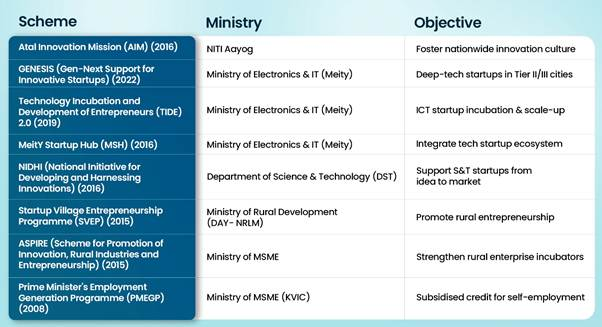
Way Ahead
- Shift from “Valuation-led” to “Value-led” Growth: There is a need to Move beyond the unicorn obsession towards sustainable, profitable business models.
- Deep-Tech Priority: Treat sectors like AI, semiconductors, space tech, biotech as part of economic and national security.
- Decentralised Innovation Clusters: Move beyond metro-centric growth to cluster-based innovation ecosystems such as;
- Agri-tech clusters in rural belts,
- Manufacturing clusters in industrial corridors,
- Deep-tech hubs near research institutions.
Concluding remarks
- The decade from 2016 to 2025 has witnessed the emergence of a vibrant and geographically diverse startup ecosystem in India.
- Supported by favourable policies, growing investor confidence, and widespread entrepreneurial participation, India has established itself among the world’s leading startup nations and strengthened its position as a global innovation hub.
Source: TH
Previous article
New IIP Series Reflecting India’s Changing Industrial Structure
Next article
The Middle Class Journey: Progress Powered by Policy
